Vampyr
Satyre
Activist

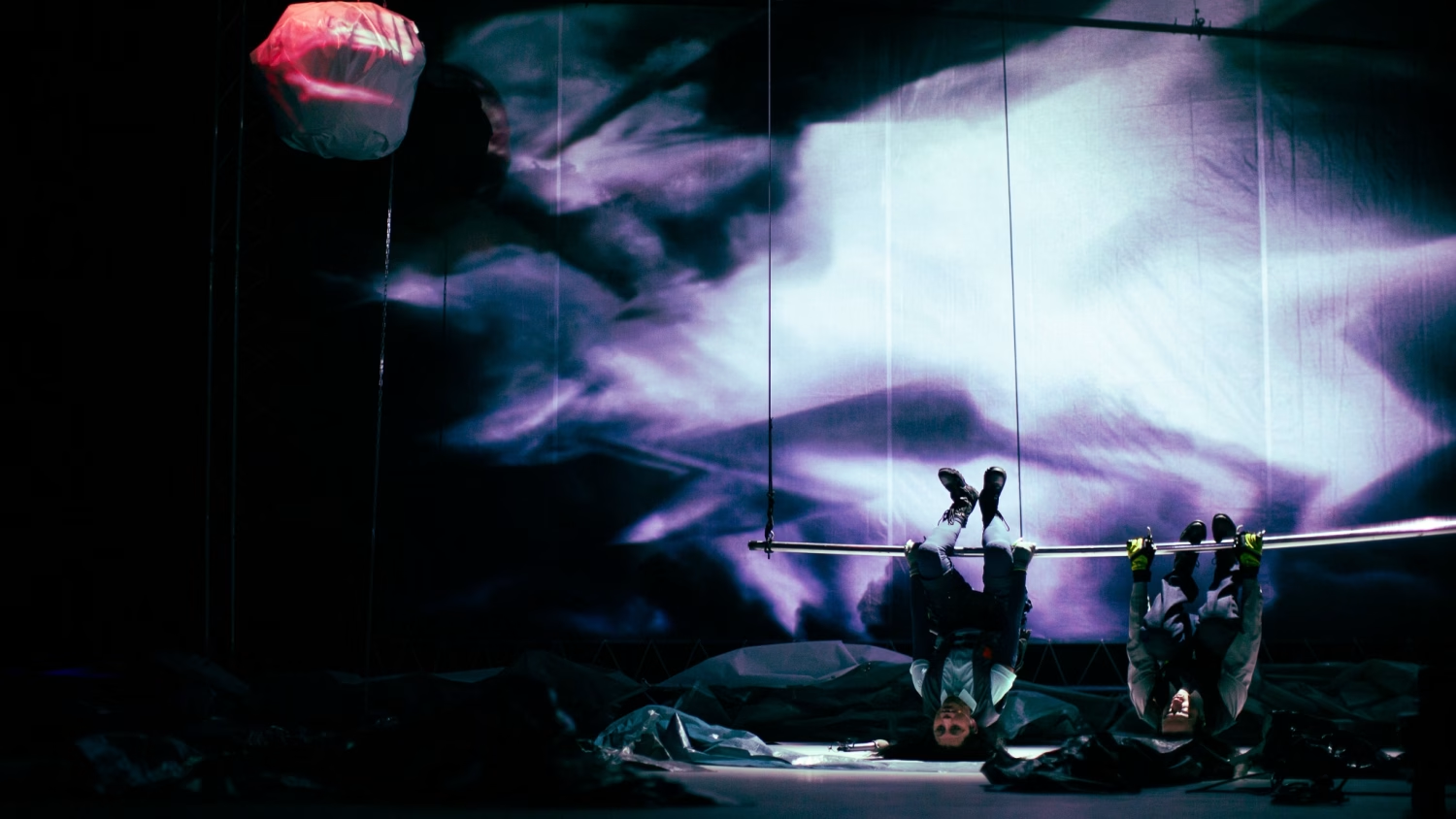
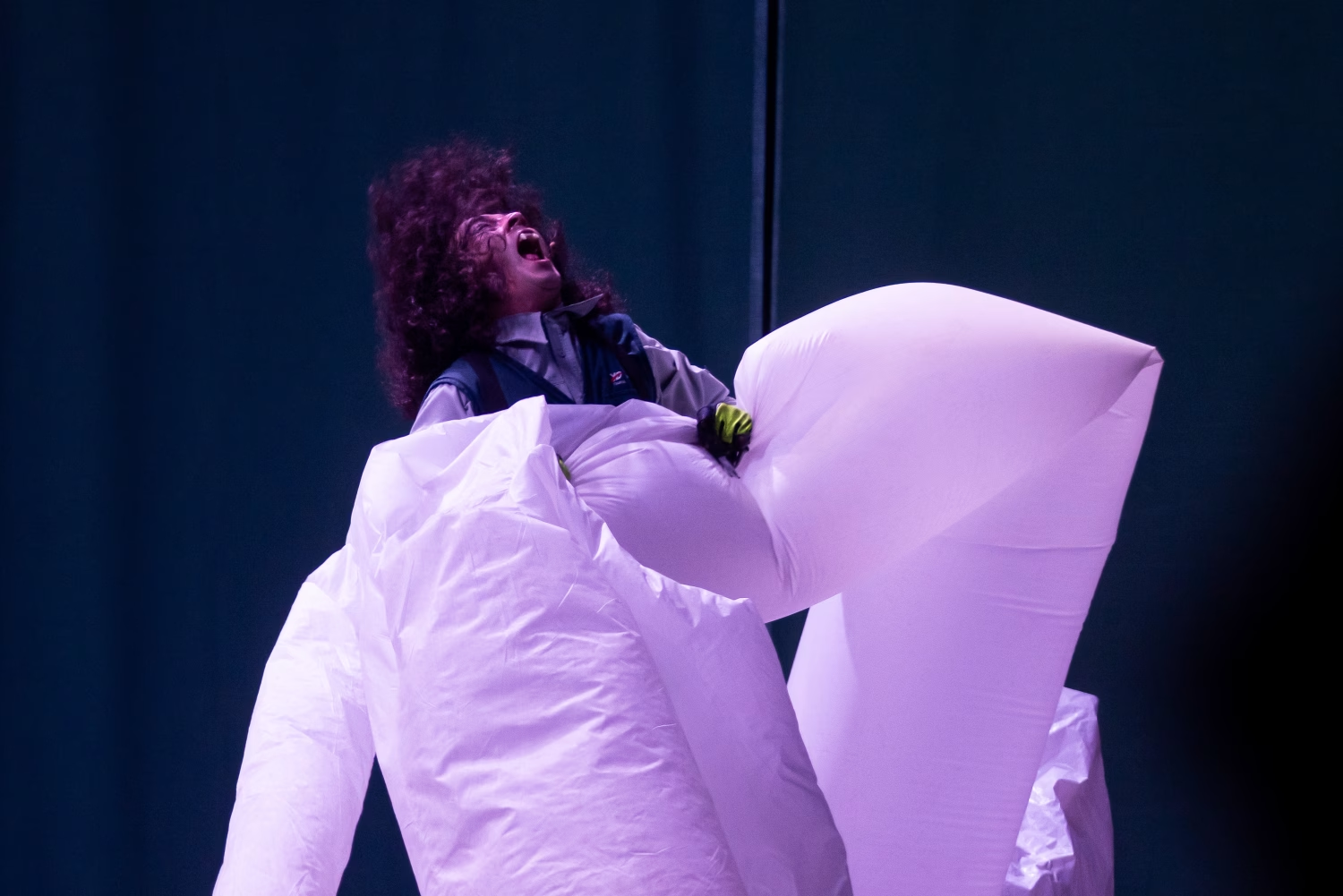
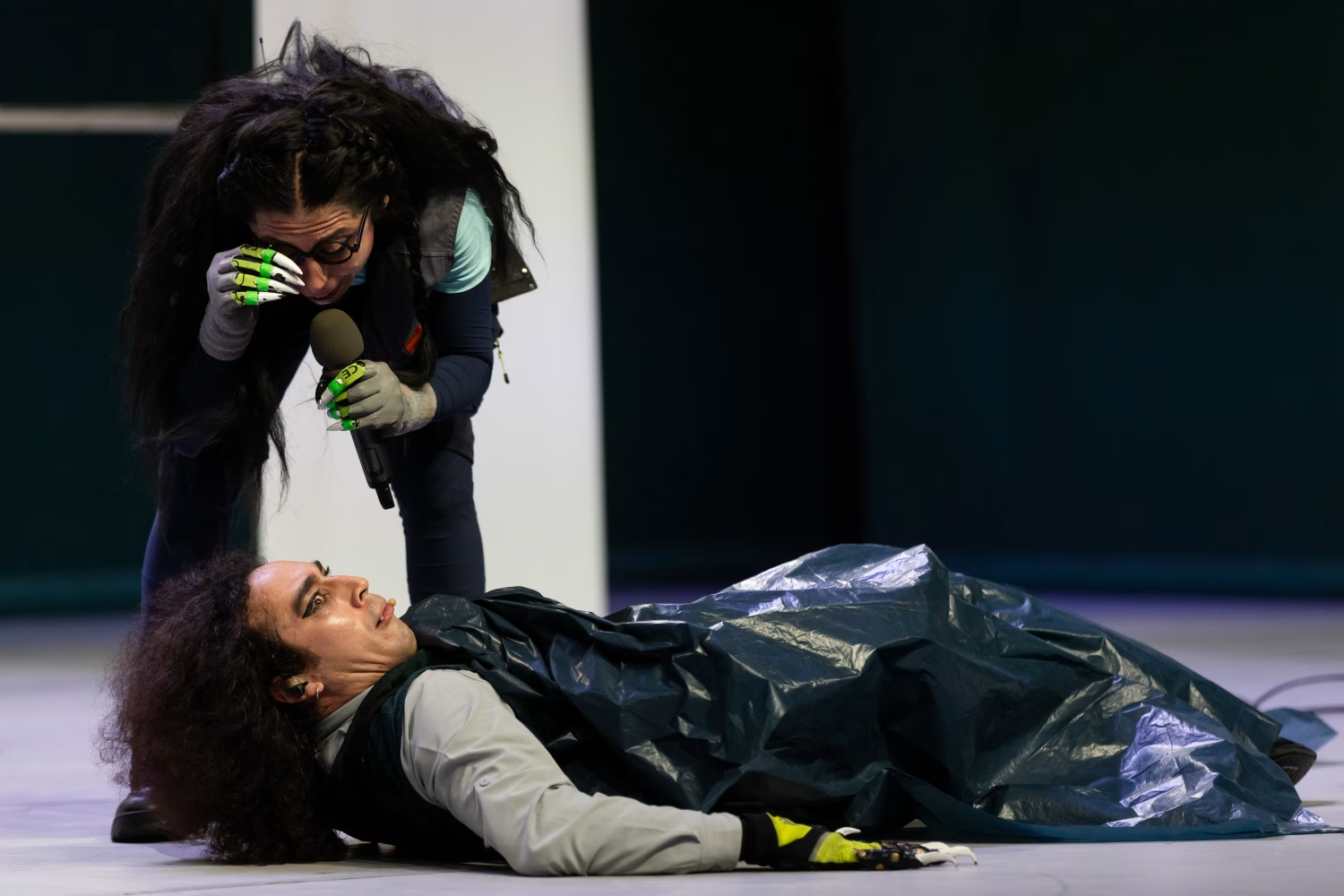
There are rumours. There was an incident Friday morning. An incident which prompted the report. The impact report. The environmental impact report. It is important to talk to everyone. The night workers. The wind turbine company directors. And do not forget the bats. Discover the incredible physical play of actors David Gaete and Marcela Salinas in this ecogothic satire. The Chilean Manuela Infante revisits with cutting humour the myth of the vampire in its South American version. But isn’t insatiability and purely human characteristic ?



Credits
A production of Manuela Infante
Script, Directing and Sound Design Manuela Infante
Interpretation David Gaete et Marcela Salinas
Set Design, Lights, Props and Costumes Rocio Hernández
Assistant Director and Technical Director Pablo Mois
Choreography and Training Dian C. Guevara
Sound Víctor Muñoz
Research and Dramaturgy Camila Valladares
Costume Confection Elizabeth Pérez
Production Manager Carmina Infante Güell
Coproduction Centro Cultural Matucana 100, Espacio Checoeslovaquia, Centro Cultural de España, NAVE (Santiago), Beykoz Kundura (Istanbul)
With the support of the Universidad Academia Humanismo Cristiano, Oxiluz Iluminación, Cultura Violeta (Santiago)
Presented in collaboration with Maison Théâtre et le Festival TransAmérique
Création au Centro Cultural M100, Santiago, le 22 août 2024
Traduction David Dalgleish
The show is hilarious, but also very cynical. Is it inspired by a true story ? When did you first hear about wind turbines affecting the populations of bats ?
It´s absolutely a true story. The territories of South America are subject to extreme forms of exploitation. This has been going on since hundreds of years ago as we all know. But we are now seeing the growth of a new iteration of colonial exploitation: it has been called green neo-colonialism: the perpetuation of practices of extraction and appropriation of colonial logic, which persist under the veil of green energy production, what some people call: greenwashing.
In Chile, we often use the term «zonas de sacrificio» – sacrifice zones – to describe areas that have been devastated by exploitation. I find this expression very telling, because it points to the fact that certain lives and territories are treated as expendable in the name of economic development. My work tries to show that these sacrifice zones are inhabited – by dense constellations of life, death, and exploitation. In that sense, the vampire is the perfect figure: a creature made up of many parts, embodying ambiguity and a kind of undefined existence. As it’s put in the piece: «part dead, part alive, part human, part animal, part earth.»
I find the concept of sustainability deeply problematic. Even the term itself contains a trap: «to sustain» – but to sustain what exactly? All too often, it’s about sustaining -perpetuating- the same system that depletes both human and non-human resources. It feels more like a technological shift in the mechanisms of exploitation – and sometimes, simply a shift in who gets to exploit whom.
Colonialism destroyed entangled cosmologies in which the human and the non-human weren’t seen as separate. But these ways of thinking have survived. I see theatre as a place for that resistance, where such imposed categories can be challenged. So inventing a «vampiro sudaka» – a Latin American vampire – becomes an act of disobedience. It’s not some posh European Dracula, sitting in his library. Our vampire is a wild, hybrid creature that breaks apart colonial notions of identity.
Donna Haraway argues that, to exploit the other, you first have to symbolically kill it – by cutting yourself off from it, turning it into something external. «I’m human, that’s animal»; «I’m culture, that’s nature». Those separations are what make exploitation possible in the first place. That’s why we need to question such categories – they were created to justify colonial appropriation.
There’s growing fascination with the non-human – especially in artistic and academic circles in the Global North. But what’s often overlooked is that the very lines we now try to blur were once drawn to enable colonial practices. If we understand colonialism as the appropriation and exploitation of an Other, then we can recognize that it is dependent on these separations: human from non-human, nature from culture. That’s why the «sudaka» vampire is more than a poetic image. It is an act of resistance, a way of disobeying that inherited colonial logic – a logic that still runs deep in how we see, think, and act today.
During rehearsals, we often talked about exhaustion – not just in terms of energy, but in a deeper, existential sense. What does it mean to feel exhausted? What is energy? How does it circulate? Energy is not just a resource to be extracted – it’s something that connects beings, that entangles forms of life to each other. And it deserves a way of existing that goes beyond mere utility.
We are immediately drawn in by the performers’ body language. This isn’t the first time you’ve worked on anthropocentric themes. Do fauna and flora particularly inspire your movement work?
Rehearsals were a kind of collective exploration of the indeterminate, and they began even before the text emerged. I wanted to find out how, through performativity and physical work, we could subvert the idea of fixed beings – of individuals as coherent, self-contained, clearly defined subjects.
How can we question this rigid, monocultural idea that you have to be identical with yourself? In theatre, there’s often this assumption that a character needs to be consistent – to have a clear, stable identity. But in this project, I’m exploring the opposite: beings that resist coherence, that are permeable, open, porous. Together with the performers, we explored how this state can be embodied on stage.
We’ve been working with a concept by Peruvian anthropologist Marisol de la Cadena that I really like – the idea of the «not only». The notion that everything is what it is – and not only that. She calls it a «negative lever»: when we say a cup is a cup – and not only – we open up a space where the fixing of that identity can be interrupted. I’m interested in how fragility can be embodied: that sensation of drifting, of being entangled in something you can’t control.
This is exactly what we explored in rehearsals: How do you embody an animal – and not only? What does it mean to be human – and not only? The physicality that emerges is the result of constantly shifting, expanding, slipping beyond what is being represented in the moment. When we work on the physicality of an animal, there is also – subtly – the presence of an elderly person. But not only. A dead body resonates in the movement too. The performers continuously play with these layers, resisting any clear-cut or fixed reading of what they represent.
This creates a body that is constantly shifting – vibrating, indeterminate, never fully fixed. The two performers put themselves in a highly exposed position, because the work they do on stage is neither comfortable nor familiar. It’s deeply performative: it happens in the here and now of each performance. Together, we developed specific techniques to keep this movement alive in the body – this active resistance to any closed or final definition.
About Manuela Infante
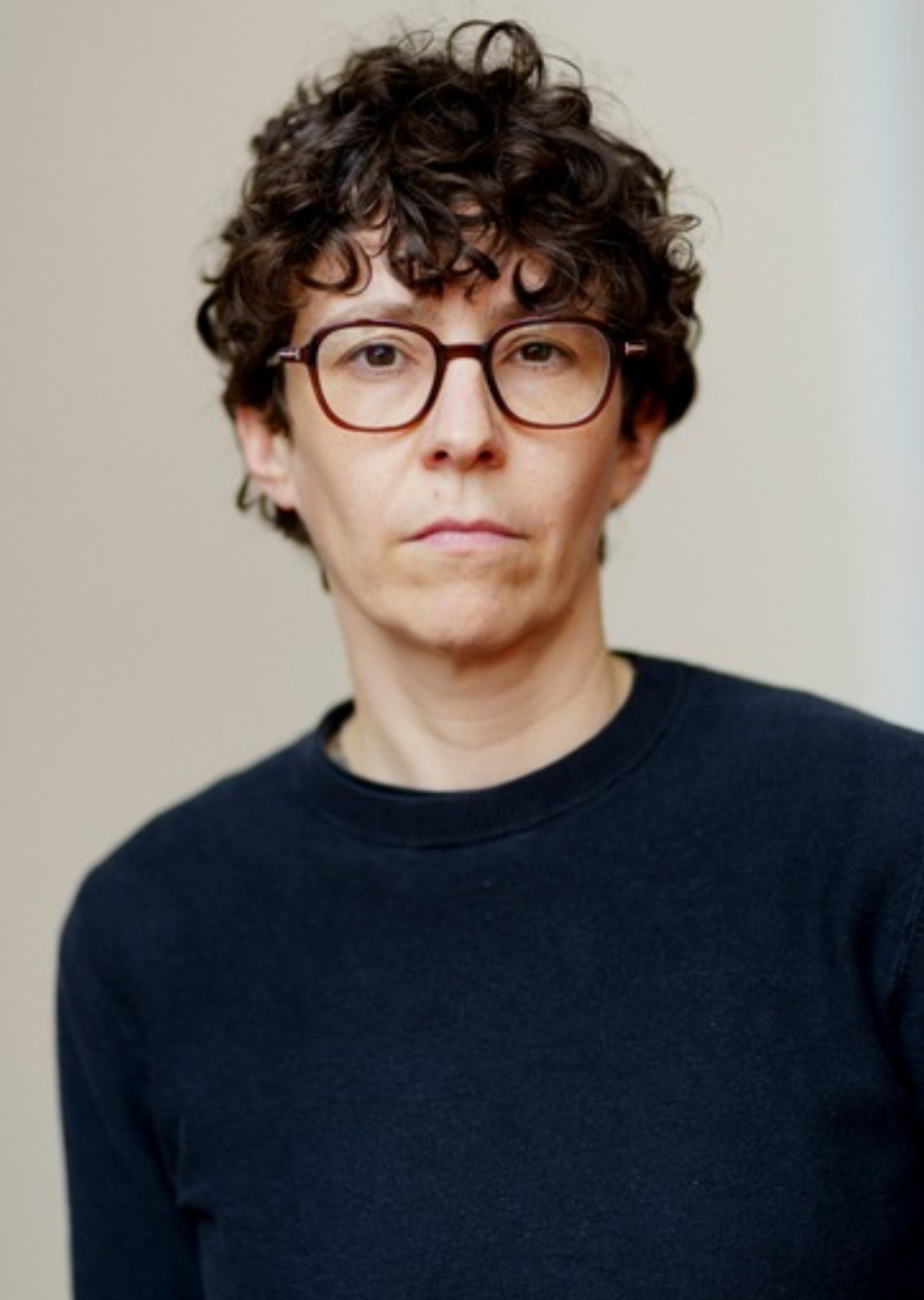
Director, playwright, and musician Manuela Infante Güell is considered one of the most influential voices in contemporary Latin American theatre, thanks to her revolutionary, non-anthropocentric approach that challenges the binary division of nature and culture. Her work has been presented in almost twenty countries across the Americas, Europe, and Asia. In 2019, she became the first Chilean director to be invited to Venice’s Biennale Teatro with Realismo and Estado Vegetal. As a scriptwriter, she has worked with renowned Chilean filmmakers such as Francisca Alegria, Marialy Rivas, and Sebastián Lelio.
Vampyr pursues the exploration of post-human theatre that she began in Estado Vegetal (FTA 2020) and Cómo convertirse en Piedra, which focused on the vegetable and mineral worlds. In her latest work, South American vampires become agents of resistance in the fight against extractivism and green neocolonialism. Her critique of the European vampire legend targets the colonial mindset, which creates artificial boundaries between the human and non-human worlds. This distinction offers a pretext for the exploitative practices that are now ravaging the nations of the Global South.